
By: Doris Jeruto
Have you ever looked at Kenya’s waste management laws and policies and thought, “We’re really on top of this”? On paper, we should be leading the region. We’ve banned single-use plastic bags, passed the Sustainable Waste Management Act 2022, and established Extended Producer Responsibility (EPR) rules that hold companies accountable for their products long after they leave the shelves.
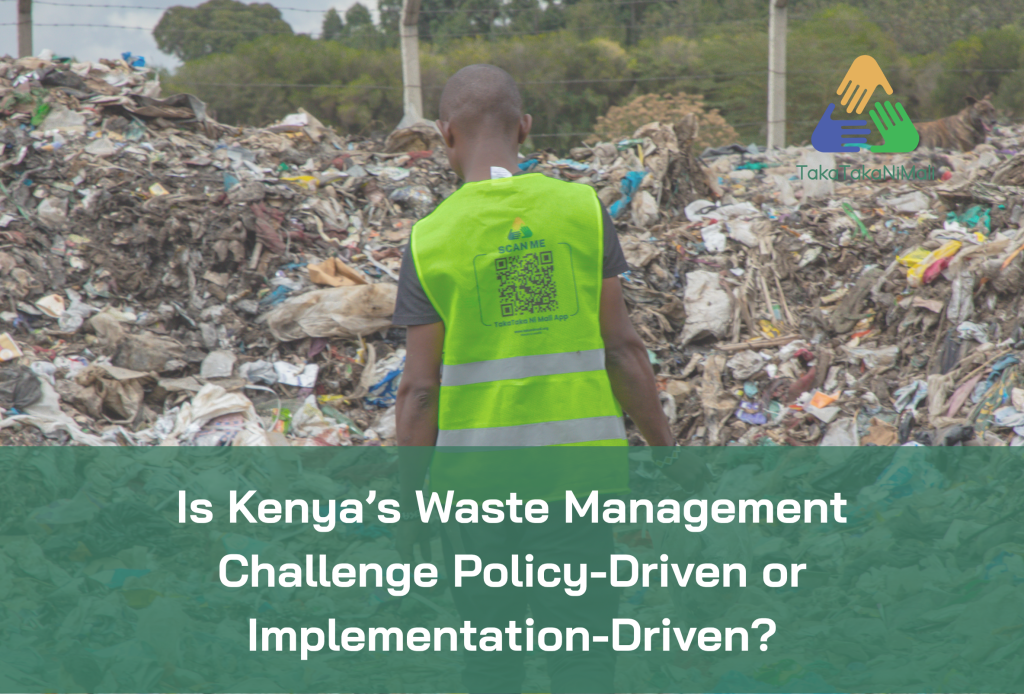
Step into any major Kenyan city and you’ll find that the reality on the pavement hasn’t quite caught up to the policy on paper. The system is under strain: collection gaps remain significant, recycling rates are low, and informal waste workers; the backbone of daily waste management, continue to operate without the recognition, protection, and support they deserve.
So, the question isn’t whether Kenya has good policies. We clearly do. The real question is: Are these policies actually working where it matters?
Kenya’s Progress in Waste Management Policies and Laws
Kenya’s progress has been driven by sustained efforts from national government ministries, regulatory agencies, county governments, and private sector and civil society actors. Key laws, regulations, and policies include:
- Environmental Management and Coordination Act (EMCA), 1999 (amended 2015): Developed by the Government of Kenya and implemented by NEMA, this overarching law guides environmental management across the country.
- Plastic Bag Ban (2017): One of the world’s strictest bans on single-use plastic bags, introduced by the Ministry of Environment and Forestry and enforced by NEMA, signaling Kenya’s commitment to reducing plastic pollution.
- Sustainable Waste Management Act (2022): Signed into law on 7th July 2022, this Act lays the foundation for transitioning from waste disposal to a circular economy. It mandates county-level Material Recovery Facilities (MRFs), with full implementation still underway.
- Extended Producer Responsibility (EPR) Regulations (2023): Spearheaded by NEMA, these regulations require producers to take responsibility for post-consumer waste, incentivizing better product design, collection, and recycling.
- Environmental Management and Coordination (Waste Management) Regulations: Operational standards for waste collection, segregation, transport, and disposal under EMCA.
- County-Level Waste Management Regulations: Localized rules guiding collection, segregation, and disposal in alignment with national standards.
- Plastic Waste Management Regulations & Proposed East African Community (EAC) Single-Use Plastics (SUP) Bill: Measures to complement the 2017 plastic bag ban and harmonize single-use plastics standards regionally.
- Circular Economy and Resource Efficiency Initiatives: Programs championed by government, private sector, and development partners to promote recycling, upcycling, and sustainable resource use.
These policies demonstrate Kenya’s leadership and provide a clear framework for progress. Yet translating them into tangible, day-to-day outcomes is where the real work begins.
Challenges in Implementation
Even the strongest policies face the ultimate test when they meet everyday reality. In Kenya, waste management laws are ambitious and forward-thinking, yet turning them into consistent, visible results across cities and towns is no easy task. Understanding these gaps is key to finding solutions that actually work.
Here are the main challenges slowing the implementation of policies and laws in Kenya’s waste management sector:
- Infrastructure Gaps: Many counties still lack the trucks, Material Recovery Facilities (MRFs), and processing sites needed to make waste systems work. Without the right “hardware,” even the best policies remain on paper.
- Informal Sector Inclusion: Informal waste workers handle most of our urban waste, yet systems to include them fairly,with safety equipment, fair pay, and social protection,are still being built.
- SME Compliance Challenges: Small and medium enterprises often struggle to meet Extended Producer Responsibility (EPR) requirements, limiting their role in Kenya’s circular economy.
- Single-Use Plastics (SUPs): The plastic bag ban has cut some waste streams, but many other SUPs remain in circulation. The draft EAC SUP Bill signals ongoing efforts to harmonize and enforce reductions regionally.
- Policy Coordination Across Counties: Implementation differs from one county to another, depending on leadership, priorities, and enforcement capacity, creating uneven service delivery.
- Public Awareness & Behavioural Change: Households and businesses are still learning how to segregate waste, recycle effectively, and participate in circular initiatives, slowing progress.
- Funding & Investment Gaps: Even with laws in place, limited funding for operations, monitoring, and innovation continues to hold back new circular economy initiatives.
Policy Adoption: Evidence in Numbers
While Kenya’s policies are strong, statistics show where adoption is succeeding and where gaps remain:
- Waste Collection vs. Recycling: Kenya collects about 70 % of its total waste, yet only a small fraction of recyclable material, less than 10 % for plastics and under 20 % for paper; is actually recycled, highlighting the gap between policy intent and outcomes (kpp.or.ke).
- EPR Uptake by Producers: Early adoption of the Mandatory EPR regulations shows strong willingness by producers to comply, with hundreds of firms registered by the 2025 deadline, signaling growing industry engagement (kepro.co.ke).
- Informal Sector Contribution: Informal waste workers handle up to 80 % of on-the-ground recovery, demonstrating the critical need to integrate these “unsung heroes” into formal systems for sustainable impact (cejadkenya.org).
These figures illustrate that while policies are being adopted and producing some positive results, much work remains to translate adoption into measurable, system-wide outcomes.
Where Policy is meeting reality
Concrete progress is emerging across multiple fronts, showing that Kenya’s policies are starting to bear fruit:
- Formal Recognition of Waste Workers: In March 2026, the Ministry of Environment and NEMA held a national forum for waste pickers, formally recognizing them as environmental workers under the 2022 Act. This step integrates informal workers into formal social protection and payment systems, giving them dignity, security, and a clear role in the circular economy.
- Investment Explosion: At the Kenya International Investment Conference (KIICO 2026), the government launched the Waste Management and Circular Economy Investment Prospectus, creating a pipeline of bankable projects worth over $700 million. This demonstrates that the sector is increasingly viewed as regulated, high-growth, and ready for meaningful participation.
- Rise of Producer Responsibility Organizations (PROs): Under NEMA’s EPR framework, PROs are actively funding collection centers and recycling plants, ensuring that the responsibility for post-consumer waste lies with producers, not struggling municipalities.
Lessons from TakaTaka ni Mali
We have observed that policies set direction, but practical systems are built by people and decisions guided by data are what make these systems effective. The success of Kenya’s waste management framework depends on how well laws are translated into everyday practices that serve households, businesses, and waste workers.
Based on our experience, we recommend approaches that can make policies and Laws more effective on the ground:
- Engage households and businesses: Collecting data on local waste behaviors helps design collection schedules and recycling programs that are practical, efficient, and widely adopted.
- Recognize and support waste workers: Formal recognition, fair compensation, and access to safety equipment empower the informal sector, which handles most urban waste recovery.
- Invest in accessible infrastructure: Decisions on where to place sorting and processing facilities should be guided by data on waste generation and collection gaps to maximize impact.
- Use data to inform policy implementation: Monitoring and analyzing real-world outcomes ensures that policies are responsive, measurable, and continuously improved.
- Focus on locally grounded solutions: Policies need to be operationalized in ways that reflect the realities of each county, community, and waste stream.
Strengthening Policy-Practice Linkages
TakaTaka ni Mali recently received funding from the FCDO Research Commissioning Centre (RCC) for the project:
“Catalyzing Circular Economy Models through Waste-to-Wealth Capacity Building and Policy-Practice Engagement Platforms in Kenya and East Africa.”
The project will support evidence-based policy by building stakeholder capacity and fostering collaboration between policymakers, industry, and communities, ensuring Kenya’s policies are implementable and impactful.
Bridging the Gap: From Policy to Action
To fully realize Kenya’s circular economy vision, focus must shift to operationalizing existing laws:
- Invest in Infrastructure: Build and maintain county-level collection and sorting facilities.
- Integrate the Informal Sector: Provide recognition, protection, and fair compensation to waste workers.
- Support Compliance: Strengthen NEMA enforcement while offering practical guidance for businesses of all sizes.
- Measure and Monitor Impact: Track progress to ensure policies deliver tangible, on-the-ground results.
Kenya has the vision and the policies. The next step is the hard, deliberate work of execution. Leadership in sustainable waste management and the circular economy will not be defined by laws alone, but by our ability to close the gap between policy and practice, ensuring every street, city, community, and citizen benefits.